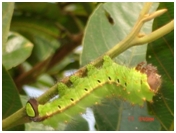
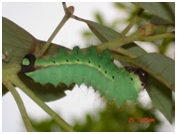
Muga silk worm is multivoltine and 5-6 crops are raised in a year out of which two commercial crops (Jethua: May- June and katia: October- November), two pre-seed crops (Jarua: December- January and Aherua: June- July) and two seed crops (Chotua: February- March and Bhodia: July- August. Usually pre-seed and seed crops encounter adverse climatic condition resulting in heavy loss during the early stages due to environmental rigours, disease incidence and infestation of pests and predators.
Package of practices
Prune 15-20% of the plants at 6 feet height 4 months prior to rearing for early stage and 5 months prior to rearing for late stage worms.
| Crop | Time of pruning | |
|---|---|---|
| Early stage worms | Late stage worms | |
| Aherua(June- July) | 1st week of march | 1st week of February |
| Bhodia (July- August) | 1st week of April | 1st week of March |
| katia(October- November) | 1st and 2nd week of July | 1st and 2nd week of June |
| Jarua(December- January) | 1st week of September | 1st week of August |
| Chotua(February- March) | 1st and 2nd week of October | 1st and 2nd week of September |
| Jethua(May- June) | 1st week of December | 1st week of November |
- Apply 30 kg FYM and N:P:K @ 44:62:17 g/plant after pruning.
- Dust bleaching powder and lime @ 200 g/m2 in the rearing plot one week before rearing.
- Consider only microscopically examined disease free eggs and incubate at 26±1 °C and 85±5 % relative humidity.
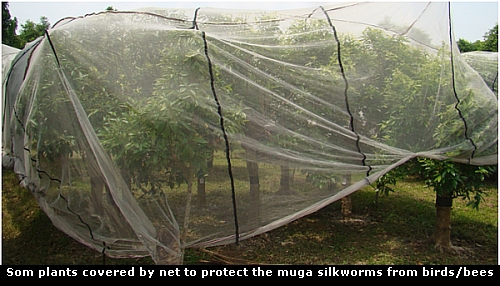
- Use nylon net to protect the early stage worms from pests and predators.
- Brush newly hatched worms on 90 days old foliage (120 days old in winter) under nylon net in between 5 to 7 AM on the opposite side of the sun.
- Consider only 1-3 days hatched worms for rearing.
- Brush 2-3 dfls per plant through visual observation of the carrying capacity of the plant.
- During extreme weather conditions i.e. hailstorm, heavy rain, whirl wind etc., brush worms indoor for 2-3 days in twigs kept in wet sand or in bottles containing water.
- Wrap the tree trunk with oil coated polythene sheet to prevent the worms from crawling down and predators from climbing up the trees.
- Avoid frequent handling of worms.
- Use disinfected Chaloni for transfer of worms.
- Transfer only the healthy and uniformly mounted worms to new plants.
- Allow the worms to spin cocoons in bamboo box type mounts (capacity 1500 worms/mount).
- Keep the mounts in semi dark, well aerated and rat proof room for better cocooning.
- Harvest cocoons only after completion of pupation (7th day in summer and 10th day in winter).
- Sort out good, flimsy, Uzi infested cocoons after harvesting
- Select well formed good cocoons for seed production as well as for reeling purpose.
Source:
- Package of practices of Muga, Eri and Mulberry Sericulture for North Eastern region of India, 2005, Central Muga Eri Research & Training Institute, Lahdoigarh, Jorhat, Assam.
- Directory of Sericulture Technology 2008, Karnataka State Sericulture Research and Development Institute, Bangalore- 560 062.