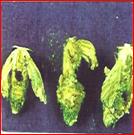
Diseases and pests of mulberry silkworm
I. DISEASES
1. GRASSERIE:
Causative agent: Bombyx mori Nuclear Polyhedrosis Virus
Occurrence: The disease prevails all through the year but its severity is more during Summer and Rainy seasons.
Source of infection: Silkworm gets infected when it feed on contaminated mulberry leaves. The milky white fluid released by the grasserie larvae, contaminated silkworm rearing house and appliances are the sources of infection.
Predisposing factors: High temperature, low humidity and poor quality mulberry leaves.
Symptoms:
- The skin of infected larvae becomes shining before moult and fails to moult.
- Inter segmental swelling appears and the colour of the body becomes yellowish.
- The infected larvae move restlessly in the rearing bed/ along the rim of the trays.
- Infected larval body ruptures easily and turbid white haemolymph oozes out.
Management:
- Practice thorough disinfection of rearing house, its surroundings and appliances with any recommended disinfectant.
- Conduct an optional disinfection with 0.3% slaked lime solution when high incidence of disease noticed in the previous crop.
- Practice personal and rearing hygiene.
- Collect the diseased larvae and ensure its proper disposal.
- Maintain optimum temperature and humidity in the rearing house.
- Feed quality mulberry leaf and avoid overcrowding.
- Apply recommended bed disinfectant as per schedule and quantity.
- Feed Amruth as per schedule to control grasserie disease.
2. FLACHERIE:
Causative agent: Bombyx mori Infectious flacherie virus/Bombyx mori Densonucleosis virus or different pathogenic bacteria viz., Streptococcus sp./Staphylococcus sp./Bacillus thuringiensis/Serratia marscesence individually or in combination of bacteria and viruses.
Occurrence: The disease is common during Summer and Rainy seasons.
Source Infection: Silkworm gets infected by eating contaminated mulberry leaf. Dead diseased silkworm, its faecal matter, gut juice, body fluid are the sources of pathogen contamination. The infection can also takes place through injuries/cuts/wounds.
Predisposing factors:Fluctuation in temperature, high humidity and poor quality of leaves.
Symptoms:
- The larvae become soft and flaccid.
- The growth of infected larvae retarded, becomes inactive and vomit gut juice. The faeces become soft with high moisture content. Sometimes chain type excreta and rectal protrusion also observed.
- Larval head and thorax become translucent.
- When infected with Bacillus thuringiensis symptoms of toxicity such as paralysis and sudden death are observed. After death, larvae turn black in color and gives foul smell.
- Some times, the dead larvae turn red when infected with Serratia sp.
Management:
- Disinfect the rearing house, its surroundings and equipments with recommended disinfectant mentioned above.
- Pick up diseased larvae and dispose them by burning.
- Provide good quality leaf grown under good Sunlight and recommended inputs. Do not provide over matured/over stored /dirty leaf to the silkworms
- Avoid starvation, overcrowding and accumulation of faeces in the rearing bed.
- Rear silkworms under optimum temperature and humidity.
- Avoid injury to the larvae.
- Apply recommended bed disinfectant as per schedule and quantity.
- Feed Amruth as per schedule to control flacherie disease.
3. MUSCARDINE:
Causative agent : Among fungal diseases, White Muscardine is common. The disease is caused by Beauveria bassiana.
Occurrence: The disease is common during Rainy and winter seasons.
Source of Infection: The infection starts when conidia come in contact with silkworm body. Mummified silkworms / alternate hosts (most are lepidopteron pests), contaminated rearing house and appliances are sources of infection.
Predisposing factors : Low temperature with high humidity.
Symptoms:
- The larvae loose appetite and become inactive.
- Presence of moist specks on the skin.
- The larva vomits and turns flaccid.
- After death, larva gradually becomes hard followed by mummification due to growth of aerial mycelia and conidia over the body and body turns chalky white.
Management:
- Disinfect the rearing house, its surroundings and equipments with recommended disinfectant as mentioned above.
- Control mulberry pests in the mulberry garden.
- Pick up diseased larvae before mummification and dispose them by burning
- Avoid Low temperature and high humidity in the rearing house. If required use heater/stove to raise the temperature.
- Regulate bed humidity during rainy season by dusting slaked lime powder during moult.
- Apply bed disinfectant, Vijetha and Vijetha supplement/Ankush/any recommended bed disinfectant as per schedule and quantity.
4. PEBRINE:
Causative agent: Nosema bombycis / different strains of microsporidia.
Occurrence: Non-seasonal
Sources of Infection: Silkworm gets infected through eggs (Transovarian/Transovum transmission) or by eating contaminated mulberry leaf. Infected silkworms, faecal matter, contaminated rearing house and appliances and alternate hosts (mulberry pest) are the sources of infection.
Symptoms:
- Irregular hatching of silkworm eggs.
- Irregular size of the larval body and moulting.
- The infected larva looses its appetite and becomes inactive with wrinkled skin.
- Black pepper-like spots appear on the body of the infected worms.
- White postules appear on the silkgland when examined under microscope with presence of shining oval spores.
Management:
- Disinfect the rearing house, surroundings and with recommended disinfectant as mentioned above.
- Conduct strict mother moth examination and surface disinfection of silkworm eggs to produce and rear disease free layings.
- Follow strict hygiene maintenance during rearing.
- Control mulberry pests in and around the mulberry garden.
- Apply recommended bed disinfectant, Vijetha/Ankush as per schedule and quantity.
- Monitor seed crops constantly to eliminate the microspodian infection.
Disinfection of rearing house, its surroundings and appliances:
Select any recommended disinfectant for disinfection purpose. CSR&TI, Mysore has recommended the following disinfectants:
- 0.05% Asthra solution (Add 50g Asthra powder in 100 liters of water and stir thoroughly and keep for 2 hours for dissolution of the powder).
- 2.5 % Sanitech/Serichlor in 0.5% Slaked lime solution (To prepare 100 liters of solution, take 250g of activator in to a basin/bucket and add 2.5 liters of Sanitech/Serichlor solution. Keep it for 10 minutes. Add activated solution to the rest of water. To this solution, add 500 g slaked lime powder and mix thoroughly).
- 2% Bleaching powder in 0.3% slaked lime solution (To prepare 100 liters of solution, add little water to 2 kg bleaching powder and 300g slaked lime powder and make a paste. Add this paste to the rest of water and stir thoroughly. Keep for 10 minutes and use the supernatant).
- 0.3 % Slaked lime solution (optional disinfection if viral diseases noticed in previous crop – Add 300g of slaked lime to 100 liters of water and stir thoroughly. Keep for 10 minutes and use supernatant).
- The total requirement of disinfectant solution for disinfection is estimated based on the rearing house floor area (Length × Breadth of floor).
- The quantity of disinfectant solution required is 1.5 lt./sq. m or 140 ml/sq. ft. floor area of rearing house (height 3 m /10 ft.) + 10% of total quantity of disinfectant solution.
- Disinfect the rearing house, appliances and surroundings by spraying the solution with power sprayer. Two times disinfection recommended for each crop (once 3days before initiation of rearing and after completion of rearing).
II. PESTS
1. Uzi fly
Uzi fly 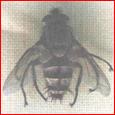 |
Egg of uzi fly  |
Black scar  |
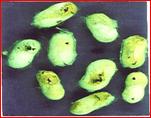
Damage to cocoons  |
Occurrence & Symptom:
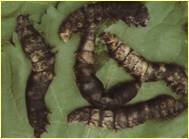
The uzi fly, Exorista bombycis is a serious endo-larval parasitoid of the silkworm, Bombyx mori, inflicting 10-15% damage to the silkworm cocoon crop in the premier silk producing states of Karnataka, Andhra Pradesh and Tamil Nadu.
Uzi fly occurs throughout the year, but severe during rainy season. Presences of eggs or black scar on the silkworm body and maggot emergence hole at the tip of the cocoon are the typical symptoms of uzi fly attack.
As soon as the uzi fly enters into rearing house, it lays one or two eggs on each silkworm larva. After 2-3 days, egg hatches, enters inside the larva and feed on internal contents for 5-7 days, after which it comes out by rupturing the larva. The maggot pupates in a dark corner or cracks & crevices in about 18-24 hours. The pupal stage lasts for 10-12 days. If the uzi fly infests at last instar, the uzi maggots come out after cocoon formation by making a circular hole.
Control measures
Exclusion Method
- Provide wire mesh/nylon net on all windows/doors.
- Provide doors with automatic closing mechanism.
- Provide anteroom at the entrance of the rearing house.
- Keep the leaf in the verandah of the rearing house and observe for the uzi fly before shifting leaf into the rearing house.
Physical (using uzi trap)
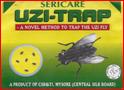
Dissolve one table in 1 litre of water and keep the solution in white trays both inside and out side the rearing house at window base from 3rd instar onwards up to spinning.
Place uzi traps inside the rearing house/mounting hall after spinning up to 20 days under close-door condition to trap uzi flies emerging inside.
Biological
- Release Nesolynx thymus (a pupal parasitoid of the uzi fly) inside rearing house on 2nd day of V instar.
- After mounting of all spinning worms transfer the same pouches near the chandrikes.
- After harvesting of cocoons keep the same pouches near the manure pit.
- Two pouches are required for 100 dfls.
Proper disposal of silkworm litter after cocoon harvest
- Separate the silkworm litter from mulberry twigs.
- Do not throw silkworm litter in open space/litter pit, as it contains hundreds of
- Uzi fly pupae. Instead, pack it in plastic bags and keep for 15 to 20 days to prevent the emergence of uzi fly from litter. Alternatively, it can be buried in soil or burnt immediately.
Availability of Nesolynx thymus:
Available at Pest Management Lab., CSRTI, Mysore. Place indents on the day of brushing, indicating the number of pouches required and brushing date of silkworms. Supply is made by courier on receipt of advance payment @ Rs 25 per pouch.
2. Dermestid beetles
Occurrence & Symptom:
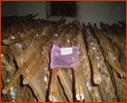
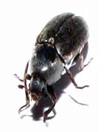
Dermestid beetles, Dermestis ater are known to attack pierced cocoons in cocoon storage rooms. The female beetles lay about 150-250 eggs in the floss of cocoons. The beetles migrate from cocoon storage room to grainage and attack green cocoons as well as moths also. Generally they attack the abdominal region of the moth. The damage is estimated to be 16.62% on cocoons and 3.57% on moths.
Management of Dermestid beetles:
Preventive measures
- Storage of rejected cocoons and perished eggs for long period should be avoided.
- Rearing house & cocoon storage rooms should be cleaned periodically.
- Grainage premises should be cleaned before & after moth emergence.
- Provide wire mesh to door & windows in pierced cocoon (PC) storage rooms.
- Wooden articles of storage room & grainage should be dipped in 0.2% malathion solution for 2-3 minutes. Trays etc., should be thoroughly washed & sun dried for 2-3 days before reusing.
Mechanical control: Collect the grubs and adults by sweeping or by using a vacuum cleaner, destroy by burning or dipping in soap water.
Chemical control:
- Store pierced cocoons in Deltamethrin treated bags ie., soak the bags in 0.028% Deltamethrin solution (1 ltr : 100 ltr water) and dry in shade.
- Spray 0.028% Deltamethrin solution on walls and floor of PC room once in 3 months.
- Sprinkle bleaching powder (200 gm/sq.mt) all around inner wall of PC room to prevent crawling of grubs from PC room.
Source:
Central Sericultural Research & Training Institute, Mysore, Karnataka