Diseases & Pests of Mulberry Food Plants
FOLIAR DISEASES
1. Leaf Spot
Pathogen : Cercospora moricola
Occurrence : It is more prevalent during rainy season followed by winter. The disease starts progressing 35-40 days after
pruning (DAP)/leaf harvesting and becomes severe on the 70th DAP.
Crop loss : 10-12 %
Symptoms : Brownish necrotic, irregular spots appear on the leaf surface. Spots enlarge, extend and join together leaving
characteristic ‘shot hole’. Leaves become yellow and wither off as disease becomes severe.

Leaf spot
Factors responsible for spreading of the disease:
- The disease is air borne spreading by conidia primarily through rain droplets.
- Temperature of 24-26 ºC and 70-80 % relative humidity are most congenial for the disease development.
Control measures to be adopted:
- Spraying of 0.2 % Bavistin (Carbendazim 50% WP) solution on the leaves.
- Safe Period: 5 days.
2. Powdery Mildew
Pathogen : Phyllactinia corylea
Occurrence : Disease is prevalent during winter and rainy seasons and progresses 40th DAP/leaf harvest becoming
severe on 70th DAP.
Crop loss : 5-10%
Symptoms : White powdery patches appear on the lower surface of the leaves. The corresponding portions on the upper
surface develop chlorotic lesions. When severe, the white powdery patches turn to brownish-black; the leaves become yellow, coarse and loose
their nutritive value.

Powdery mildew
Factors responsible for spreading of the disease:
- The disease is air borne spreading by conidia primarily through wind current.
- Temperature of 24 – 28º C and high relative humidity (75-80 %) are responsible for infection and disease development.
Control measures to be adopted:
- Follow wider spacing of plantation (90 cm x 90 cm) or paired row planting system [(90 +150) × 60 cm]
- Spraying of 0.2 % Karathane (Dinocap 30% EC) / Bavistin on the lower surface of the leaves. Safe period 5 days.
- Or spray Sulfex (80WP) 0.2%, safe period 15 days.
3. Leaf Rust
Pathogen : Cerotelium fici
Occurrence : The disease is more prevalent during winter and rainy seasons. It starts progressing 45-50 DAP becoming
severe on 70th DAP. The mature leaves are more prone to the disease
Crop loss : 10-15%
Symptoms : Initially, circular pinhead sized brown eruptive lesions appear on the leaves and later leaves become yellow
and wither off.

Leaf rust
Factors responsible for spreading of the disease:
- The disease is air borne dispersing by uredospores through water droplets and wind current.
- Temperature of 22-26°C and high relative humidity above 70 % are favourable for the disease development.
Control measures to be adopted:
- Follow wider spacing of plantation (90 cm x 90 cm) or paired row planting system [(90+150) × 60 cm]
- Avoid delayed leaf harvest
- Spraying 0.2% Kavach (Chlorothalonil 75 % WP) on the leaves
- Safe period: 5 days
4. Sooty mould
Pathogen : A group of fungi
Occurrence: The disease is more prevalent during winter (August-December) season.
Crop loss: 10-15%
Symptoms : Thick black coating develops on the upper surface of the leaves.
Factors responsible for spreading of the disease:
- The disease occurs due to the presence of white flies in the mulberry field.
- The fungi develop on the honey like substance produced by the whiteflies.
- Temperature of 20-24° C and high relative humidity above 70 % are favourable for the disease development.
Control measures to be adopted:
- Spray 0.2% Indofil-M45 to check growth of saprophytic fungi
- Foliar spray of 0.02% monocrotophos on 15th and 30th day after pruning to control white fly infestation.
- Safe period: 15 days.
II. ROOT DISEASES
1. Root knot
Causal organism: Meloidogyne incognita (Nematode)
Occurrence: The disease is out break through out the year and more common in sandy soils under irrigated
conditions.
Crop loss: 20 %
Symptoms:
- Severely affected mulberry plants show stunted growth with low water moisture in leaves, later yellowing of leaf margins.
- Formation of knots / galls on roots is the main indicator of the disease symptom.
- Galls are spherical and vary in size; young galls are too small and yellowish-white in colour, old galls are big and pale brown.


Root knot nematode disease
Factors for spreading the disease
- Disease spreads primarily through contaminated soil, farm implements and run-off irrigation.
- Planting of infected saplings along with other susceptible crops increases the disease intensity, some susceptible weeds in and around the
mulberry gardens act as the secondary sources of infection
- Temperature between 27-30 ºC, soil moisture of less than 40 % and pH of 5 to 7 are favorable for the development of the root
knot disease.
Control measure:
- Apply neem oil cake @ 800 kg/acre/yr in 4 split doses during intercultural operation or after pruning the plant or after leaf harvest by
making the trenches of 10 –15 cm deep near the root zone of plant and cover with soil and irrigate.
2. Root rot
Causal organism : Rhizoctonia bataticola (= Macrophomina phaseolina)
Associated secondary microbes : Fusarium solani/ F. oxysporum/ Botryodiplodia theobromae
Occurrence: Throughout the year in all types of soils especially when the soil moisture and organic matter in soil are
low.
Crop loss: 15 % and above depending on the soil health and climate.
Symptoms: Initially the above ground symptom of the disease appears sudden withering of plants and leaves fall off from
the bottom of the branches and progressing upwards.


Above ground symptoms of root rot (yellowing/withering of leaves)
- The below ground symptoms include decaying of root cortex or skin, turn black due to fungal spores/ mycelium below the bark (Fig
13).
- The severely affected plants loose the hold in the soil and can be easily uprooted.
- On severity, the entire root system gets decayed and plants die.
- Affected plants after pruning, either fail to sprout or plant sprouted bears small and pale yellow leaves with rough surface.


Below ground symptoms of root rot (rotting of the roots)
Factors for spreading the disease:
- The disease occurs in soils of high temperature (28 – 34ºC), low moisture (below 40 %) and low organic matter.
- The disease spreads primarily through contaminated soil, farm implements and irrigation. The secondary source of infestation is through
diseased saplings, irrigation and cultivation practices.
Control measure: A target specific new formulation “Navinya” (herbal 80% & chemicals 20%) is used
for the control of root rot disease of mulberry
Method of application : Prune off the dried shoots above 15-30 cm from ground. Make shallow ring around stump and
apply the Navinya solution made by adding 10 g of Navinya in 1 liter of water (i.e. 1 kg Navinya in 100 liter water; sufficient for 100 plants @ 1
liter/plant). Pour the solution over the pruned stump to drench completely. Cover with soil around the stump to prevent exposure to sunlight. Treat
the surrounding mulberry plants also to prevent spreading of the disease.
Precautions to be taken:
- Do not irrigate the treated mulberry plants during the first 4-5 days.
- Remove the dead mulberry plants and burn and expose the soil to sunlight.
- Plant the new saplings after dipping their roots in 0.2 % Navinya solution for 30 minutes before planting.
- Maintain optimum organic content >0.5% in soils by applying compost/ manure.
- During summer months irrigate the garden to keep the soil moisture around 50-60% to prevent the disease.
III. PESTS
1. Pink Mealy bug
Occurrence & Symptom : Pink mealybug, Maconellicoccus hirsutus (Green) causes deformity symptom in mulberry
which is popularly called as Tukra. Leaves become dark green, wrinkled & thickened with shortened inter nodal distance resulting in
bunchy top appearance/resetting of leaves. It occurs throughout the year, but severe during summer months. Mulberry leaf yield is reduced by
4,500 kg/ha/yr due to this pest.
Control measures
Mechanical control:


Clip off the infested portion by secateur, collect in a polythene bag and destroy by burning. This will help in reducing the chances of
recurrence of pest. This practice may be followed when the silkworms attain 4th age.
Chemical control: Spray 0.2% DDVP 76% EC (@ 2.63 ml/lit water) 15–20 days after pruning. Safety period: 15
days.
Biological control:
Release predatory lady bird beetles Cryptolaemus montrouzieri @ 250 adult beetles or Scymnus coccivora @ 500 adult beetles in two
equal splits at an interval of 6 months.


Availability of predatory lady bird beetles: Pest Management Lab., CSR&TI, Mysore (ph. No.0821-2903285) cost: Rs 120 per unit.
2. Papaya mealy bug


Occurrence & Symptom: The papaya mealy bug, Paracoccus marginatus is an exotic pest which infest a variety of crops such as
papaya, guava, teak, vegetables, Jatropha, and weed plants like Parthenium, Sida, Abutilon etc. In mulberry its infestation causes malformation
of affected portion, stunted growth of leaf, presence of red/black ants, honey dew secretion, growth of sooty mould, and outright killing of the
plant. At present occurrence of papaya mealy bug is sporadic.
CLASSICAL BIOLOGICAL CONTROL OF PAPAYA MEALYBUG
- Release exotic parasitoid, Acerophagus papayae @1 vial per acre (1 vial= about 100 adult parasitoids).
- Do not remove or
destroy alternate host plants such as Parthenium, Sida, Abutilon, Jatropha etc., containing mummified mealybugs.
- Do not spray any insecticide for its control, which may still worsen the situation.


Note: Exotic parasitoids are available at National Bureau of Agriculturally Important Insects (NBAII), ICAR, Bangalore
[opp: CBI, Ganganagar, Bangalore; phone no. 080-23511982/98]
3. Mulberry Leaf roller


Occurrence & Symptom : Incidence of Leaf roller, Diaphania pulverulentalis in mulberry starts with the onset of
monsoon. It occurs from June to February but reaches peak during September – October months. The larva binds mulberry leaf blades
by silken thread, stay inside & feed. Its feacal matter can be seen below the infested portion.
Control measures
Mechanical control: Remove the infested portion (along with the larva) by secateur, collect in a polythene bag and destroy
by burning.
Chemical control:
- Spray 0.076% DDVP (@ 1 ml/lit water) 12 to 15 days after pruning. Safety period: 7 days.
- Second spray of 0.5% commercial neem pesticide (0.03% Azadirachtin) @5ml/Lit water,10 days after first spray. Safety period:
10 days
.
Biological control : Release Trichogramma chilonis egg parasitoid @ 1 Tricho card/week (for 4 weeks). Do not
spray any insecticide after the release of trichogramma parasitoids.
(Note: Tricho cards are available on cost basis at Krishi Vigyan Kendra, Suttur, Nanjangud taluk, Mysore dist. or Parasite
Breeding Lab., Dept. of Agriculture, [Near DC Office] Mandya)
4. Bihar Hairy Caterpillar
Occurrence & Symptom : Incidence of Bihar hairy caterpillar, Spilarctia obliqua in mulberry starts with the onset of
monsoon. It occurs throughout the year and in certain pockets it appears sporadically. Young larvae are gregariously found feeding on the
underside of leaf giving an appearance of mesh and one can make out from distance. Grown up ones are solitary, very active, spread
throughout the field and feed voraciously on the foliage.
Control measures
Mechanical/Physical control: Collect the egg masses or gregarious young caterpillars and destroy by dipping in 0.5% soap solution or by
burning.
Chemical control:
- Spray 0.076% DDVP (@ 1 ml/lit water) 12 to 15 days after pruning. Safety period: 7 days.
- Second spray of 0.5% commercial neem pesticide (0.03% Azadirachtin) @5ml/Lit water,10 days after first spray. Safety period: 10
days.


Biological control: Release egg parasitoids Trichogramma chilonis @ 1 Tricho card/week for 4 weeks. Do
not spray any insecticide after the release of trichogramma parasitoids.


5. Thrips


Occurrence & Symptom : Thrips, Pseudodendrothrips mori, is a major pest in Tamil Nadu and minor pest in
Karnataka & Andhra Pradesh. It occurs throughout the year and severe during summer (February – April). Both adults and nymphs lacerate
the leaf tissues and suck the oozing sap. Affected leaves show streaks in early stages and yellowish/brown blotches in the advanced stage of
attack.
Control measures
Mechanical/Physical control : Use sprinkler irrigation to disturb thrips population & eggs on the underside of
mulberry leaves.


Chemical control: Spray 0.1% Rogor (@ 3 ml/lit water) 15 days after pruning. Safety period: 20 days.
Biological control: Release predatory lady bird beetles (Scymnus coccivora @ 500/acre).
6. White fly


The name white fly is derived from the whiter appearance of the adults and their tendency to fly when disturbed. Adults have a pair of floury
wings which are usually white with a few veins. In the recent years outbreak of Dialeuropora decempuncta has occurred on mulberry in southern
state of Kerala and now observed to severely infest mulberry in the irrigated belt of Karnataka covering Mysore and Mandya districts.
Occurrence & Symptom : The spiraling of waxy material is the typical symptom of white fly attack. Prolonged dry spell
followed by the hot humid weather favours the white fly flare up. Occur during the months March-June; October-December. Both nymphs and
adults pierce and suck the sap from foliage and the damaged leaf become unfit for silkworm rearing.
Control measures
Mechanical/Physical control:
- Use sprinkler irrigation to disturb white fly population.
- Fix yellow sticky traps @ 75-80 traps/acre to trap the adults.
Chemical control: Spray 0.076% DDVP (@ 1 ml/lit water) 12 days after pruning (safety period: 10 days) and second
spray with 0.05% Rogor 30% EC @ 1.5 ml/lit (safety period: 20 days)
Biological control : Release predatory lady bird beetles Cryptolaemus montrouzieri @ 250 adult beetles or Scymnus
coccivora @ 500 adult beetles/acre.
Source:
Central Sericulture Research & Training Institute, Mysore, Karnataka
Diseases and Pests of Eri Food Plants
Diseases and pests of castor
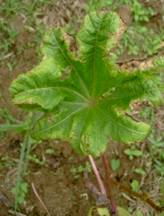
Seedling blight
Symptoms
- Young plants are affected.
- Both the surfaces of leaf turn yellow or brown with concentric brown zones on lower surface of leaf
- Stems are also affected
- Dull green round patch on cotyledons and spreads to the base.
Management
- Seed treatment with Thiram or Capton @ 3 g/kg
- Spray copper oxychoride @ 3 g/L.
Alternaria leaf blight
Symptoms
- Light brown spots on cotyledons, turn angular with age.
- Inflorescence and capsules develop sooty growth.
- Immature capsule turn brown and fall. Affected capsules have small seeds without oil
.
Stage of attack:
Seedling to maturity.
Management
- Seeds should be treated with Thiram @ 3g/kg.
- Spray 0.2% Mancozeb.
Wilt
Symptoms
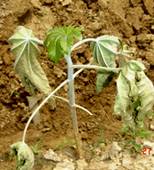
- Wilting of plants.
- Root degeneration.
- Dropping of leaves
- Necrosis of affected tissue and finally leading to death of plants
Stage of attack:
Seedling to maturity
Management
Seeds should be treated with 3g/kg Thiram or 2g/kg Carbendazim.
Cercospora leaf spot
Symptoms
Both surfaces of leaf bear black or brown spots with pale green margin. Finally turn brown and falls.
Stage of attack:
Throughout the crop.
Management
Spray 0.3% Copper oxychloride or 0.25% Mancozeb for 2-3 times.
Powdery mildew
- Symptoms: White powdery growth under the surface of the leaves. Stage of attack: November to March.
- Management: Spray 0.2% sulphur at 15 days interval during dry weather.
Red hairy caterpillar
- Nature of damage: Defoliation, more infestation in young crop. Peak season: June-August.
- Management: Spray 0.05% Monocrotophos or 0.03% Fenvalerate or 0.05% Quinalphos or 0.02% Methyl Parathion.
Semi-looper
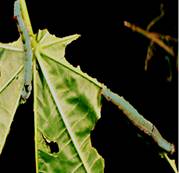
- Nature of damage: Defoliation.
- Peak Season: July-September.
- Management: Spray 0.05% Monocrotophos or 0.07% Endosulphan.
Tobacco caterpillar
- Nature of damage: Defoliation.
- Peak Season: August-October.
- Management: Spray 0.05% Chloropyriphos or 0.05% monocrotophos.
Hairy caterpillar
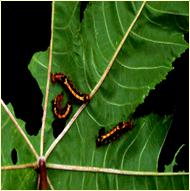
- Nature of damage: Defoliation, bore the leaves and capsules.
- Peak Season: October-December.
- Management: Spray 0.05% Chloropyriphos or 0.05% monocrotophos.
Capsule borer
- Nature of damage: Bores the capsule.
- Peak Season: November-March
- Management: Spray 0.05% monocrotophos or dust the spike with 1.5% quinolphos or 2% methyl parathion.
Jassids
- Nature of damage: Sucks the sap from plants and hopper burn symptoms on severe infestation.
- Peak Season: November-January.
- Management: Spray 0.05% monocrotophos or 0.05% dimethoate.
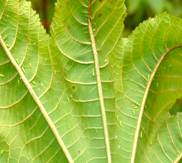
White fly
- Nature of damage: Crop gives weak appearance and sooty mould is developed on severe infestation.
- Peak Season: February-March
- Management: Spray 0.05% monocrotophos or 0.05% dimenthoate.
Diseases and pests of kesseru
- Kesseru plants are less susceptible to diseases and pests attack.
- However, attack of termite is found in most of the region.
- A beetle, which is nocturnal in habit, sometimes damages young leaves of kesseru plants.
- A Pyralid Lepidopteran pest (leaf roller) has been recorded infesting kesseru.
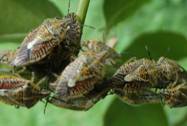
- A new pest of Brown Bug, Agonoscellis nubila Fab. (Hemiptera: Pentatomidae) on kesseru recorded during summer.
Source
- Ericulture-a comprehensive profile 2013, Directorate of Sericulture, BTC, Kokrajhar-783370, Assam.
- B.K. Singh, N. Tiken Singh, 2010, Muga Silkworm Seed Organization (MSSO), P-4 Unit, Mendipathar, East Garo Hills, Meghalaya.
- Package of practices of Muga, Eri and Mulberry Sericulture for North Eastern region of India, 2005, Central Muga Eri Research & Training Institute, Lahdoigarh, Jorhat, Assam.